


Setting up a virtual 4-way on the Z-Box hub lets you pair three Zooz switches or dimmers to control the same light—without needing a wired connection between the switches. In this setup, the main switch or dimmer is rewired as a single pole, while the remote units connects to power, neutral, and ground only.
There are three ways to program this configuration: Direct Association (recommended), Central Scene, or Rules (scenes). Direct Association allows the switches to communicate directly outside of the hub—ideal when both are added via the standard Z-Wave mesh network (this will not work for switches that are included using Z-Wave Long Range). Meanwhile, Central Scene relies on hub communication and scene commands, a perfect choice when using Z-Wave Long Range. Rules/scenes are the last option, and only recommended if you're using a hub that does not support Direct Association or Central Scene. This guide walks you through all methods, so you can choose the best fit for your setup.
Please ensure you have followed the correct wiring diagram for the virtual 4-way. There cannot be a wired connection between the smart switches.
1. Direct Association (Recommended)
*Note: Direct Association can only be used when the switches are included to the hub using the standard Z-Wave mesh protocol. Z-Wave Long Range by nature does not allow for device-to-device associations.
Our unique programming design allows our switches to be directly associated while still maintaining the correct status on each switch. Direct Association allows the switches to be linked together and communicate outside of the hub. Your Z-Wave system needs to support this feature and both switches need to be added to your hub with the same level of security.
We recommend that you use the ZEN71 On/Off switch, ZEN72 Dimmer, ZEN75 Heavy Duty Switch, ZEN30 Double Switch, ZEN32 Scene Controller, or ZEN35 Scene Dimmer models with the latest firmware for this scenario and program them according to the instructions below for the best experience. In our below example, we're using the ZEN72 Dimmer as the main dimmer (directly wired to the load) with the ZEN35 Scene Dimmer and the ZEN30 Double Switch in the remote boxes (connected to power line, neutral, and ground only):
To start, we recommend checking the firmware version on your dimmer/switch. The instructions are simpler if you are using the latest firmware on the 800 series models.
Dimmer/Switch Settings/Parameter Instructions
-
Main dimmer or on/off switch (connected to load): No changes in settings
-
Remote dimmers or on/off switches (not directly wired to the load): no changes in settings.
- If you have an earlier firmware, you will need to set Parameter 7 to value 11 (ONLY if your firmware is earlier than 3.30); this will break the direct association if used on firmware 3.30 or later.
Set the Association
On/Off Switches:
Set the association for Group 2 only, adding the device ID's for the other switch in the group:
- Add B & C to Group 2 on A
- Add A & C to Group 2 on B
- Add A & B to Group 2 on C
IMPORTANT: The remote switches can then only be used from the paddles (you need to hide them in your interface not to trigger them via Z-Wave) while any Z-Wave or wireless control of the light needs to happen from the main switch A. This will ensure all devices stay in sync at all times.
Dimmers:
Set the same associations for Group 3 only, adding the device ID's for other dimmers in the group.
- Add B & C to Group 3 on A
- Add A & C to Group 3 on B
- Add A & B to Group 3 on C
IMPORTANT: The remote dimmers can then only be used from the paddles (you need to hide it in the UI not to trigger it via Z-Wave) as any Z-Wave or wireless control of the light needs to happen from the main dimmer A. This will ensure all devices stay in sync at all times.
Below we have an example on how to program three Zooz dimmers via Direct Association in the virtual 3-way. If you're programming On/Off switches, the only difference will be to use Group 2 instead of Group 3.
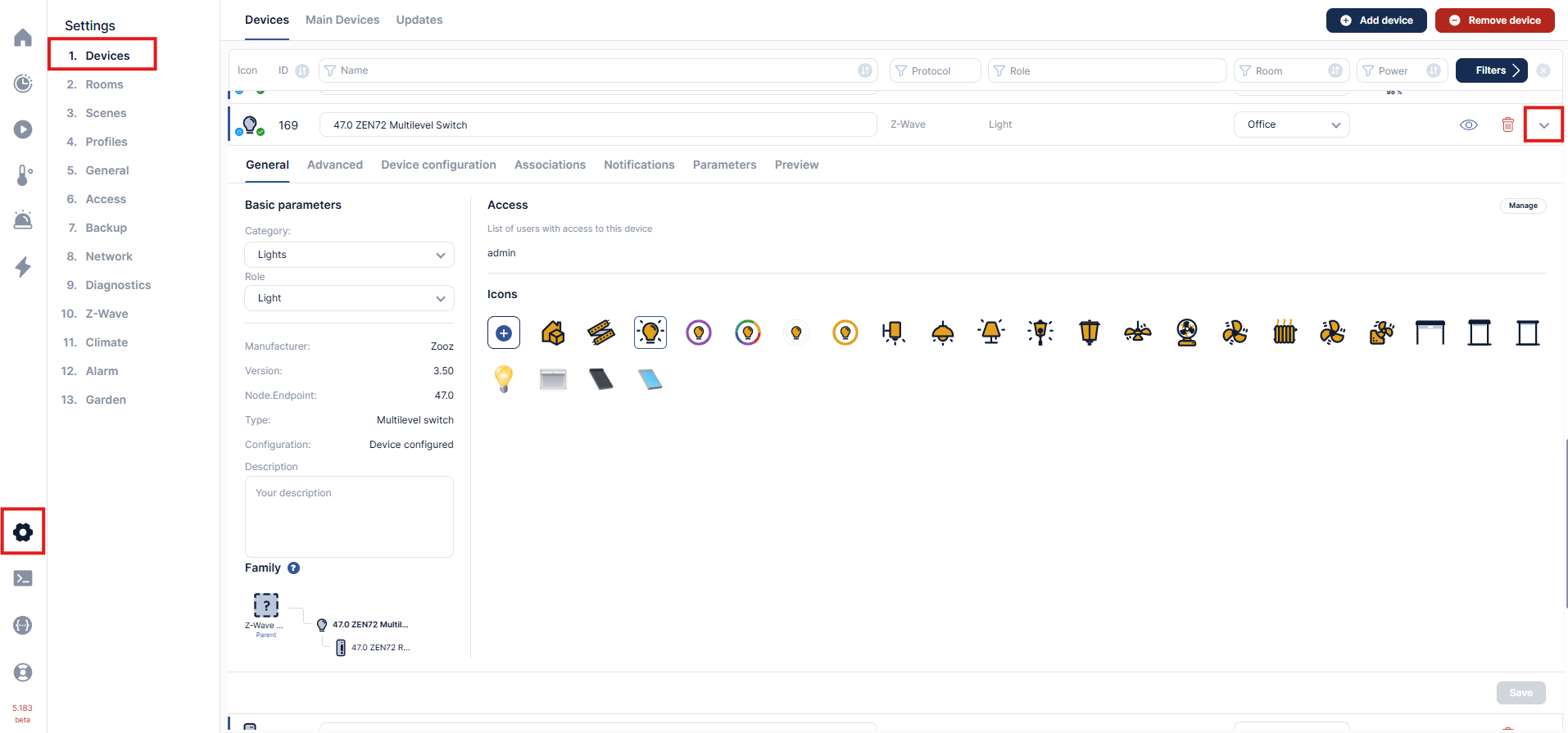
1. Dimmer A: This is our main dimmer that is directly wired to the load (ZEN72 in this example). Click Settings > Devices > Drop Down Arrow for your main Dimmer:
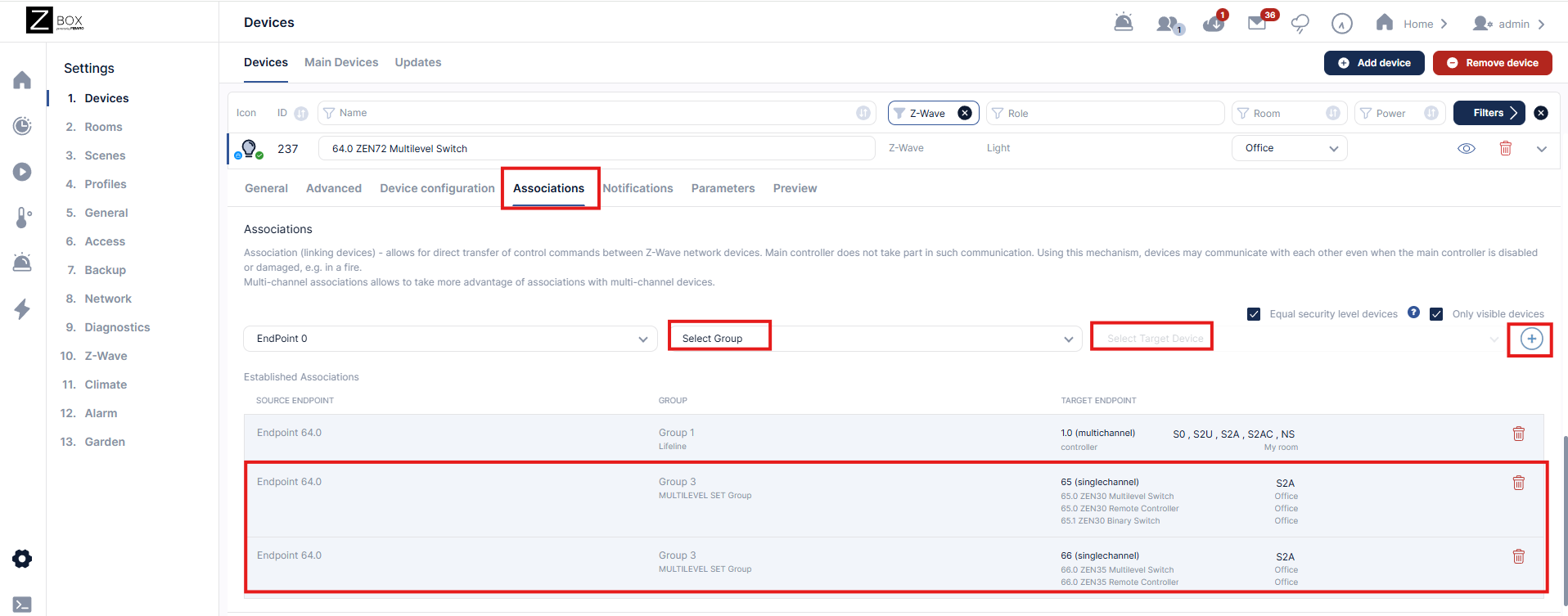
2. Select Associations. The Endpoint will stay at 0. Select Group 3 under Groups. Select your secondary dimmers as the target devices (in our example this will be the ZEN35 Scene Dimmer and the ZEN30 Double Switch). Click + to add each association. In the screenshot below, you can see that the ZEN30 Dimmer and the ZEN35 Scene Dimmer have been added to Group 3 under the ZEN72 (main dimmer).
3. Dimmer B: Repeat the process above, adding the main dimmer and Dimmer C to Group 3 for Dimmer B.
4. Dimmer C: Repeat the process above, adding the main dimmer and Dimmer B to Group 3 for Dimmer C.
Test the association by turning the light on using the paddles on the remote dimmers and the main dimmer. All devices should turn the light on and off and dim.
2. Central Scene
This option uses Z-Wave’s built-in command structure. When you tap, double-tap, or hold a switch button, the switch sends a Central Scene notification directly to the hub. The hub interprets these commands and executes the linked automations, such as turning another switch on or dimming a light. Central Scene programming happens at the protocol level—it’s part of the Z-Wave standard—and doesn’t require you to manually build multiple automations for each possible action. However, in a virtual 4-way the switches themselves don’t stay perfectly synchronized because the LED indicators rely on local device states, not hub commands. Central scene uses the status reported by each switch.
This option would be selected if your switches are included to your hub via Z-Wave Long Range.
Important Notes
- This type of communication between the devices requires that your hub is active and operational.
- The paddle on your switch will now be treated like a button on a remote control that's pressed or held - it will send only this information to the hub and should not be treated as an additional on/off device with its own status.
- After you add the switch to the hub, you need to go to the advanced settings to enable scene control on your device (it's disabled by default). If you don't change the setting first, your programming won't work.
When creating a virtual 4-way setup using Central Scene programming, only two of the three switches need to have Scene Control enabled—the two that aren't directly connected to the load.
The load switch (in the below example, a ZEN72 wired to the light) already controls the light locally. When you press its paddle, it turns the connected load on or off directly through wiring, so there’s no need for it to send scene commands. This switch will simply receive on/off or dim commands from the hub when the remote switch is used.
The remote switch (in the below example, a ZEN30 and a ZEN35 that are powered but not wired to the light) are the ones that must have scene control enabled. Because ithey don't have a load connection, they rely on Central Scene notifications to tell the hub what action should occur. The hub then runs an automation to control the load switch accordingly.
Example setup:
-
Scene 001 (upper paddle single press) → triggers a hub automation to turn the ZEN72 on
-
Scene 002 (lower paddle single press) → triggers a hub automation to turn the ZEN72 off
You can also configure dimming from the remote switch by holding and releasing the paddle and using Start Level Change and Stop Level Change commands.
In short:
-
The remote (no load) switch → Scene Control enabled.
-
The load-connected switch → Scene Control disabled. You can have this enabled if you prefer to use this for other multi-tap options, it simply isn't required in the below virtual 4-way example.
-
The hub manages the logic, translating scene events into load actions.
This method allows full virtual 4-way functionality even when Direct Association isn’t available, such as when the switches are included via Z-Wave Long Range.
Programming Steps
In the example below, we're showing the ZEN72 as the main dimmer (connected to the load) and the ZEN30 and ZEN35 as the remote switches (no load).
1. Make sure you're logged in to the WEB UI with local connection (same wifi network as your Z-Box Hub).
2. Click on Settings cogwheel > Devices and scroll to Dimmer/Switch B (no-load connected). In the below example, this is the ZEN30 Double Switch. Your Zooz switch will display as two devices: an on/off or a dimmer device and a remote controller device. Click on the arrow next to the remote controller device for the Zooz switch you would like to program > click Parameters.
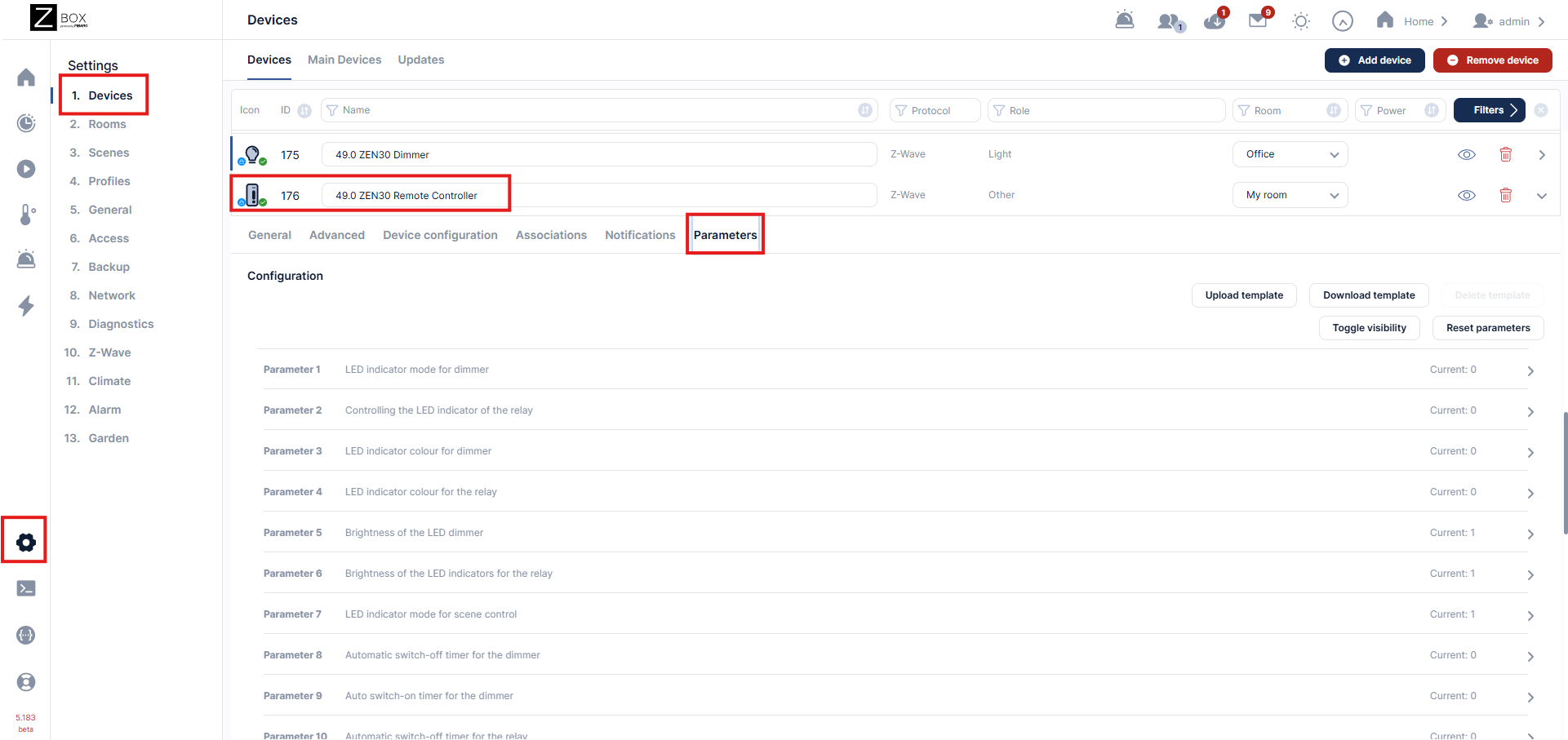
3. You'll see the settings for the device listed - click on the arrow next to the Scene Control setting to enable it. Click Save. (Scene control is enabled by default on the ZEN30, so this model is good to go with no changes).
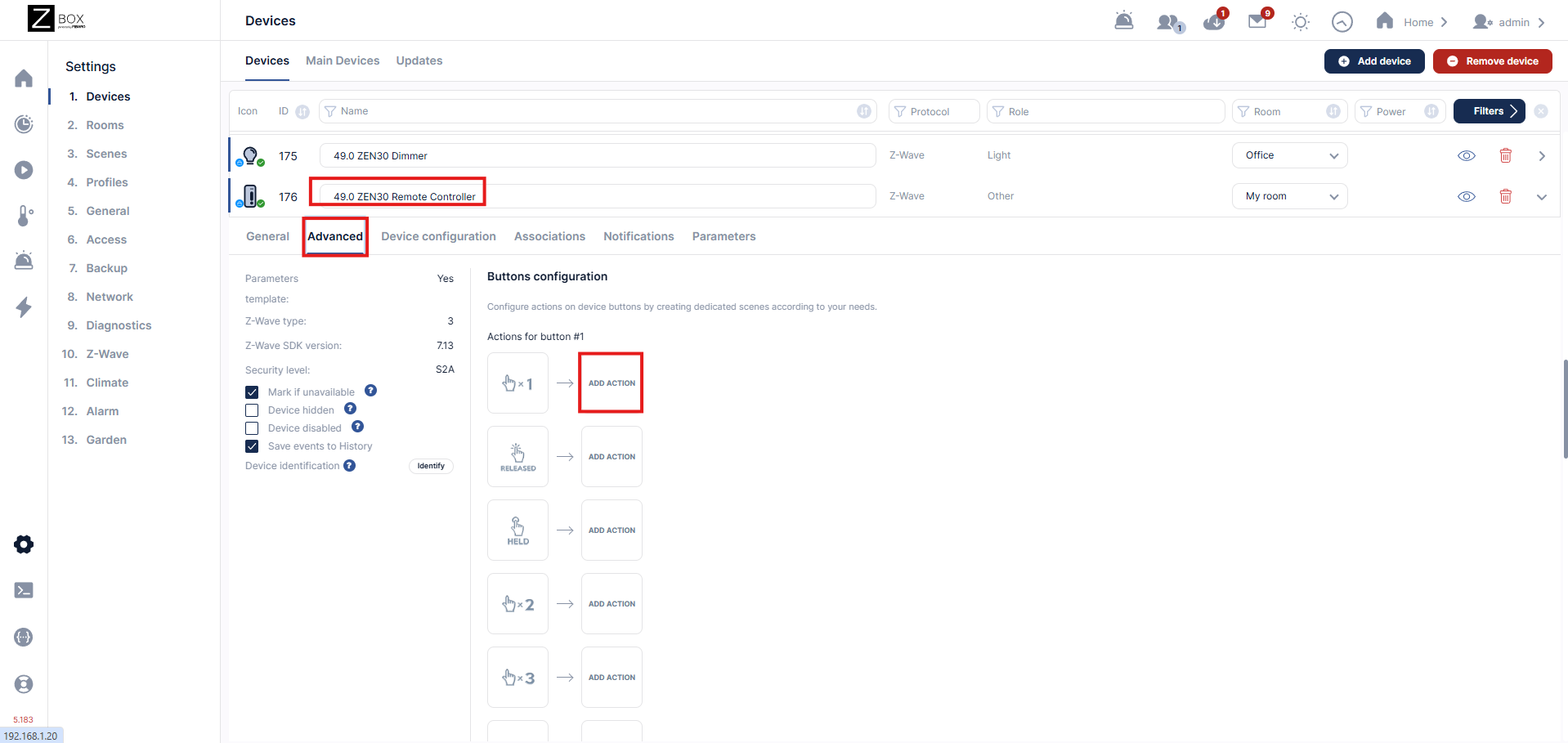
4. Click on the ZEN30 Remote Controller's Advanced tab to see the button trigger menu and assign actions to the paddles of your switch. Button 1 refers to the top paddle and button 2 refers to the bottom paddle on your switch. Simply click on the "ADD ACTION" button to start a new scene for the trigger of your choice. For our example, we are using the single tap on the upper paddle (button 1).
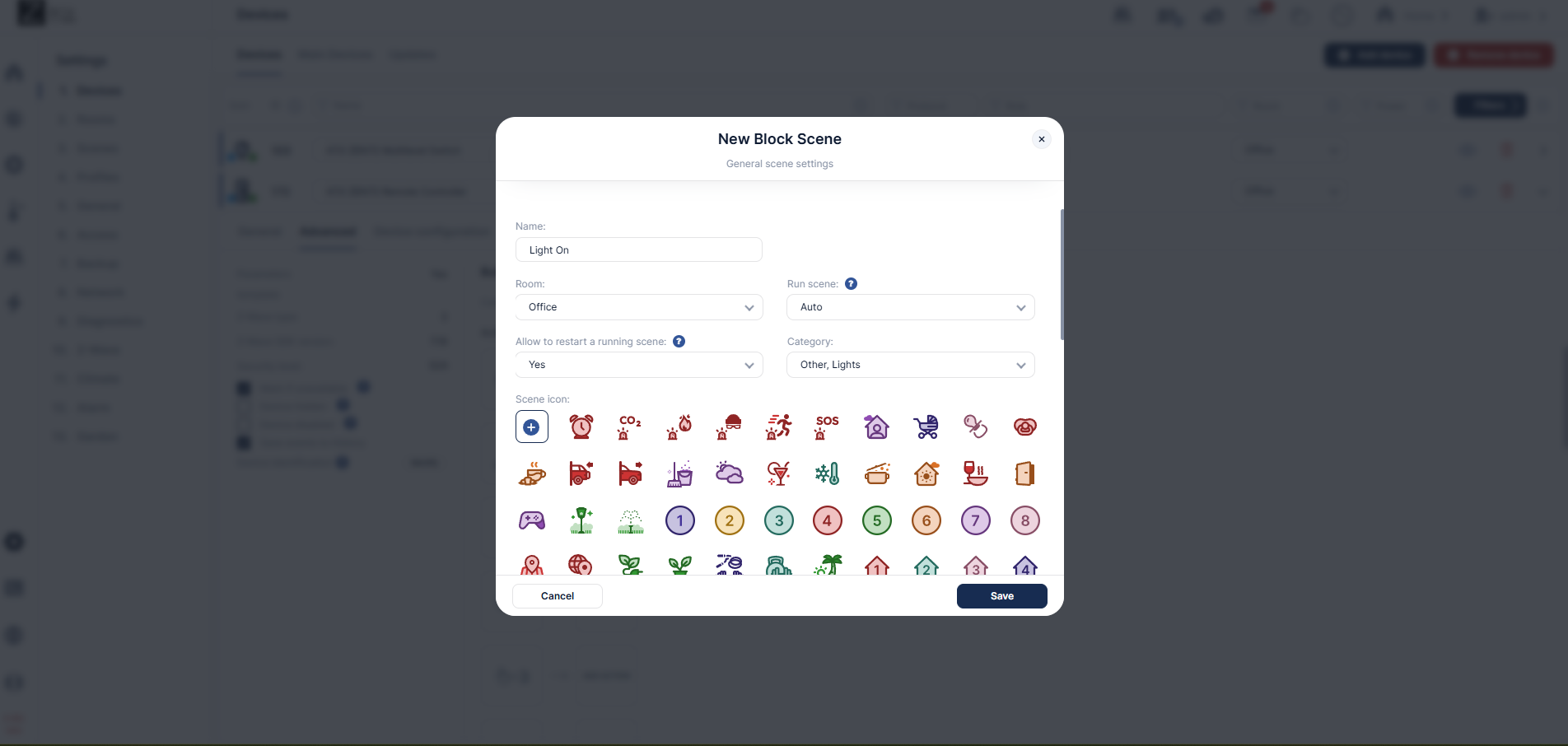
5. The block scene creator will pop up. Name your scene, select the room, etc. and click Save when done.
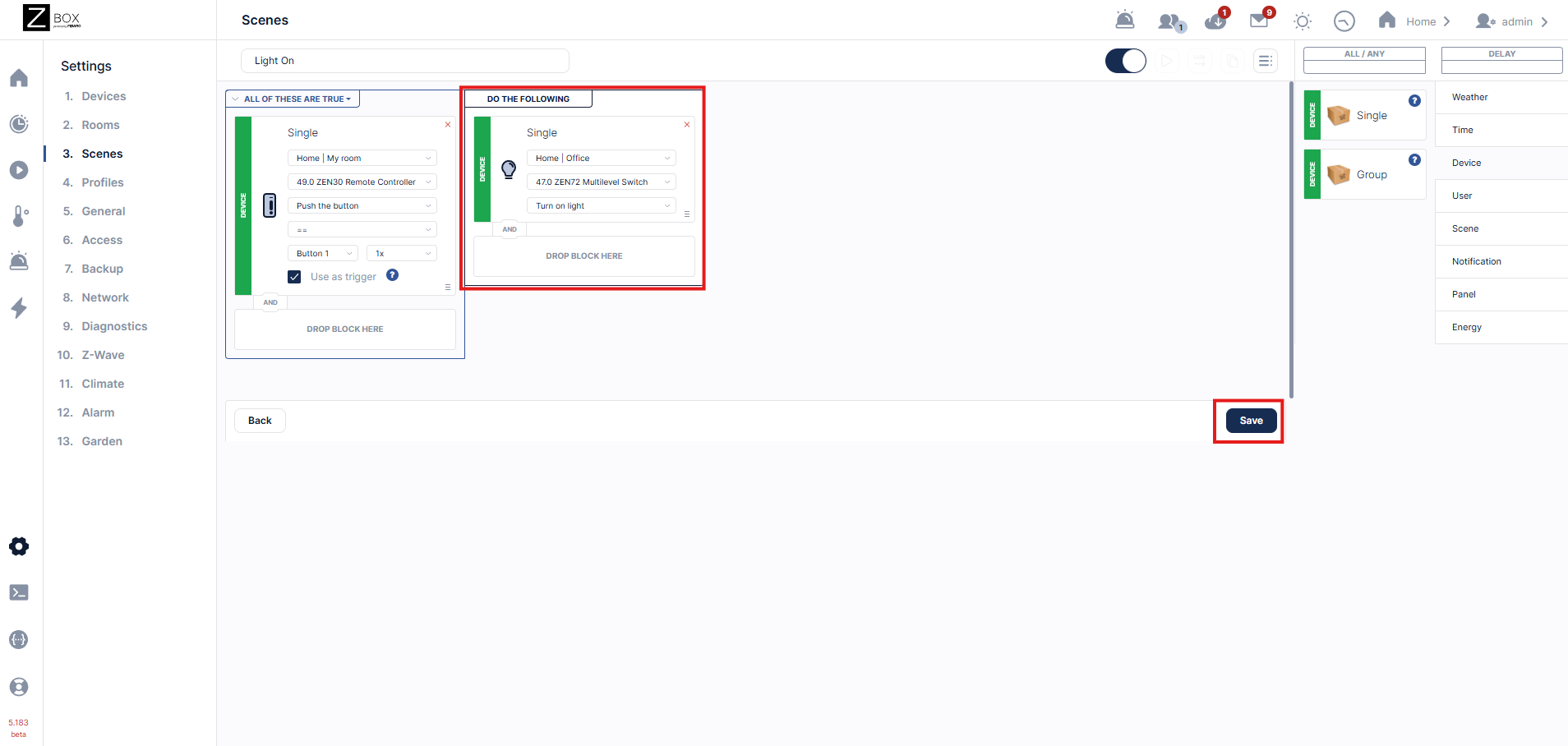
6. The ZEN30 details will be automatically populated in the first section of the block scene builder. Drag and drop the Single device tile to the Do The Following section. Select your main dimmer (load dimmer); in this example we're using the ZEN72. Set the behavior to turn on the light. Click Save when done.
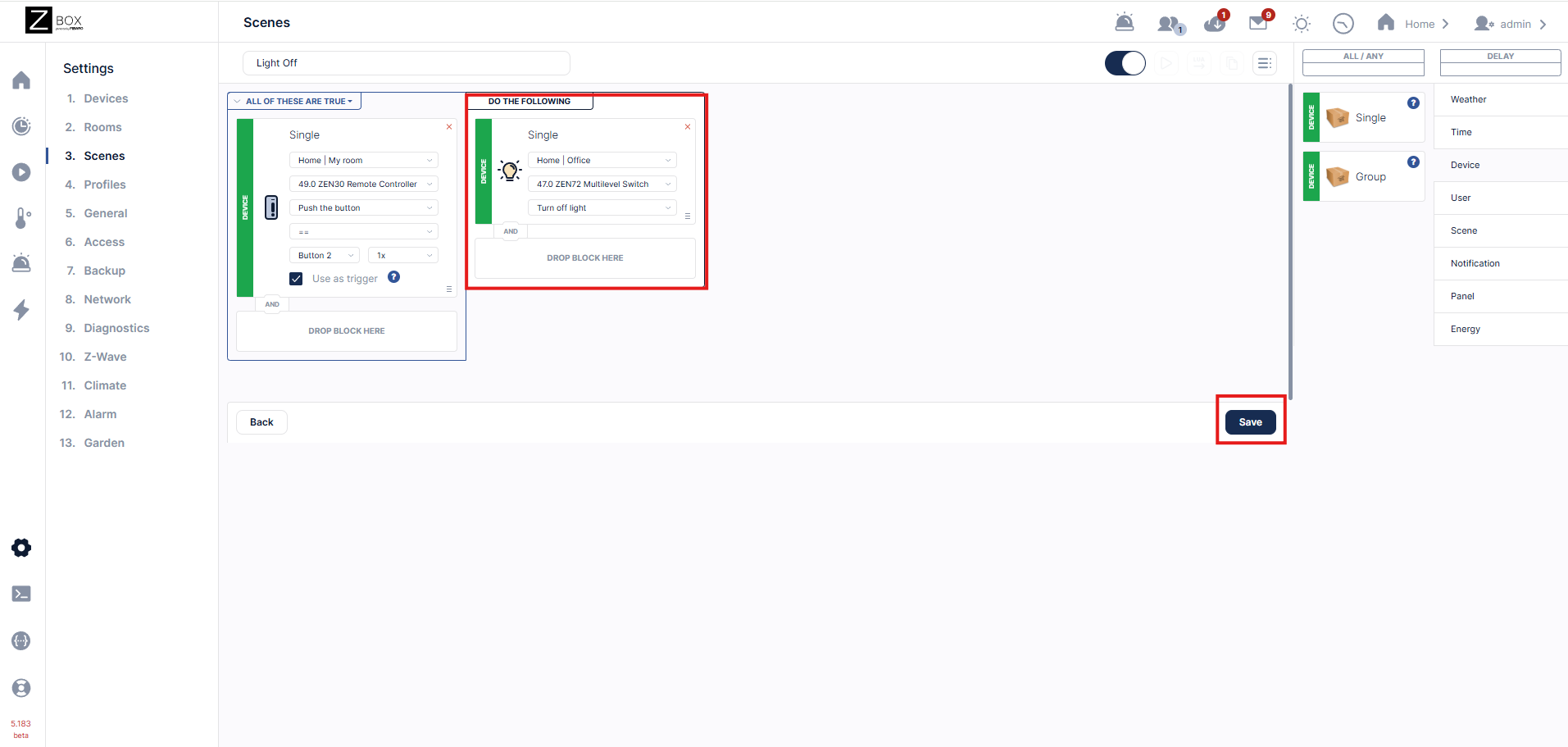
7. Go back to your devices and repeat the process, this time using Button 2 on the ZEN30 (this is the lower paddle) to turn off the light:
Your light is now controllable both from the load switch (ZEN72) and the remote switch (ZEN30).
8. You'll need to repeat this process for the third dimmer (ZEN35).
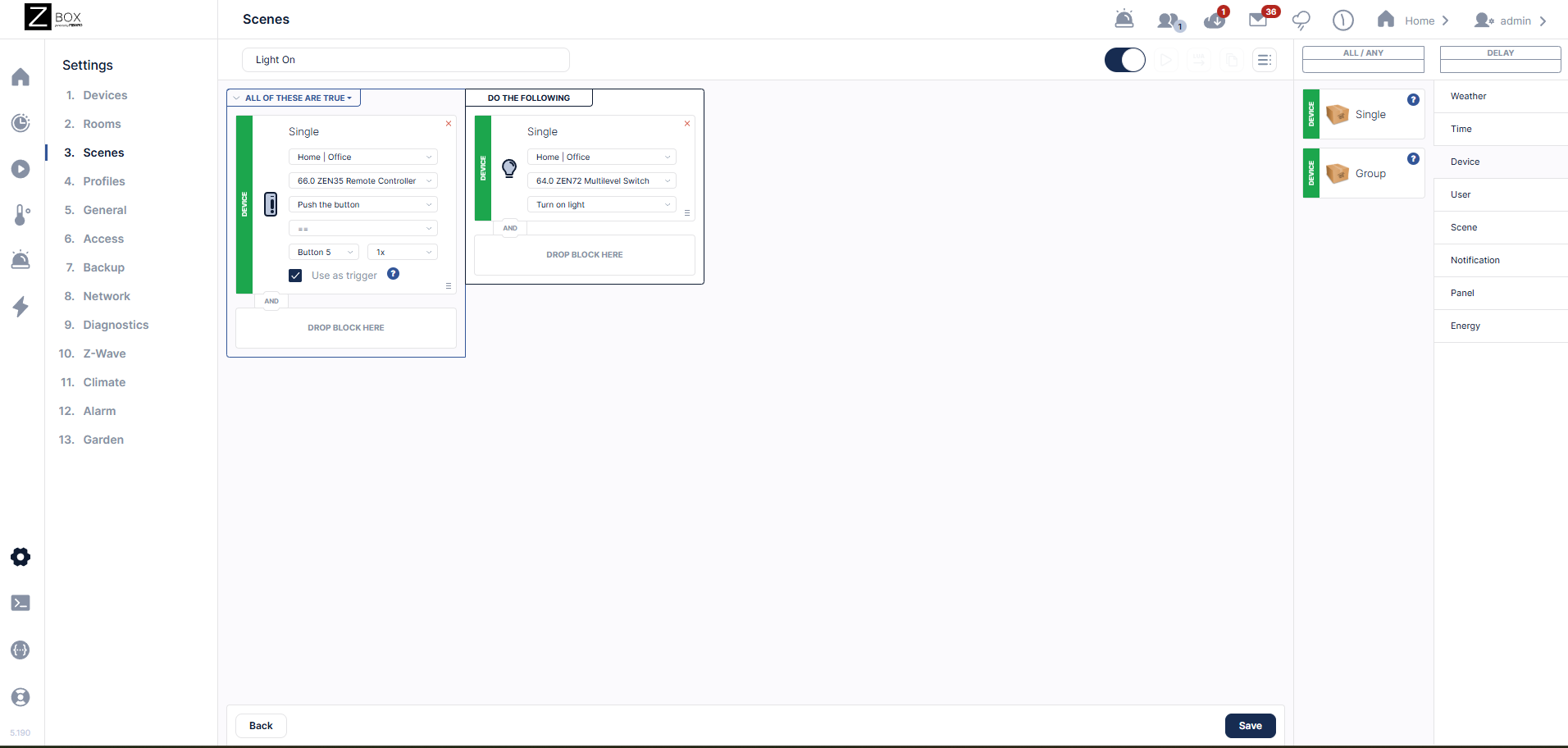
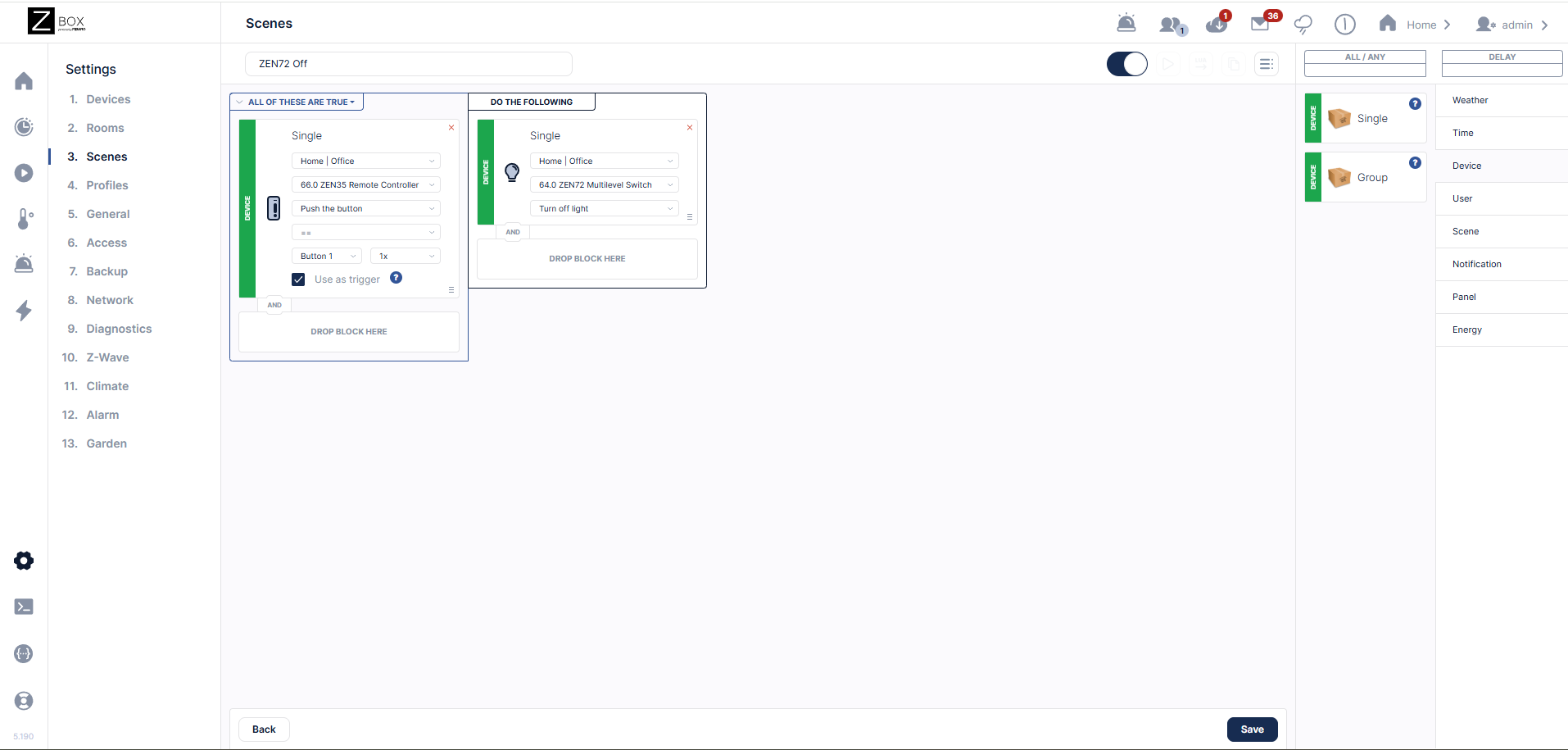
Your light is now controllable from all 3 switches in your virtual 4-way!
3. Smart Rules
In most interfaces, this is simply called scenes. This is a higher-level automation feature managed entirely by the hub. Instead of using Central Scene commands, you manually define a set of actions for each event—turn this device on, set that one to 50%, etc. To make two switches behave like a 3-way, you’d typically need 6 separate scenes: one for turning on from switch A, one for turning off from A, one for turning on from B, one for turning off from B, one for turning on from C, and one for turning off from C. While this keeps both switches synchronized, it generates more Z-Wave traffic and adds complexity, since every state change must be processed by the hub and distributed to all devices involved.
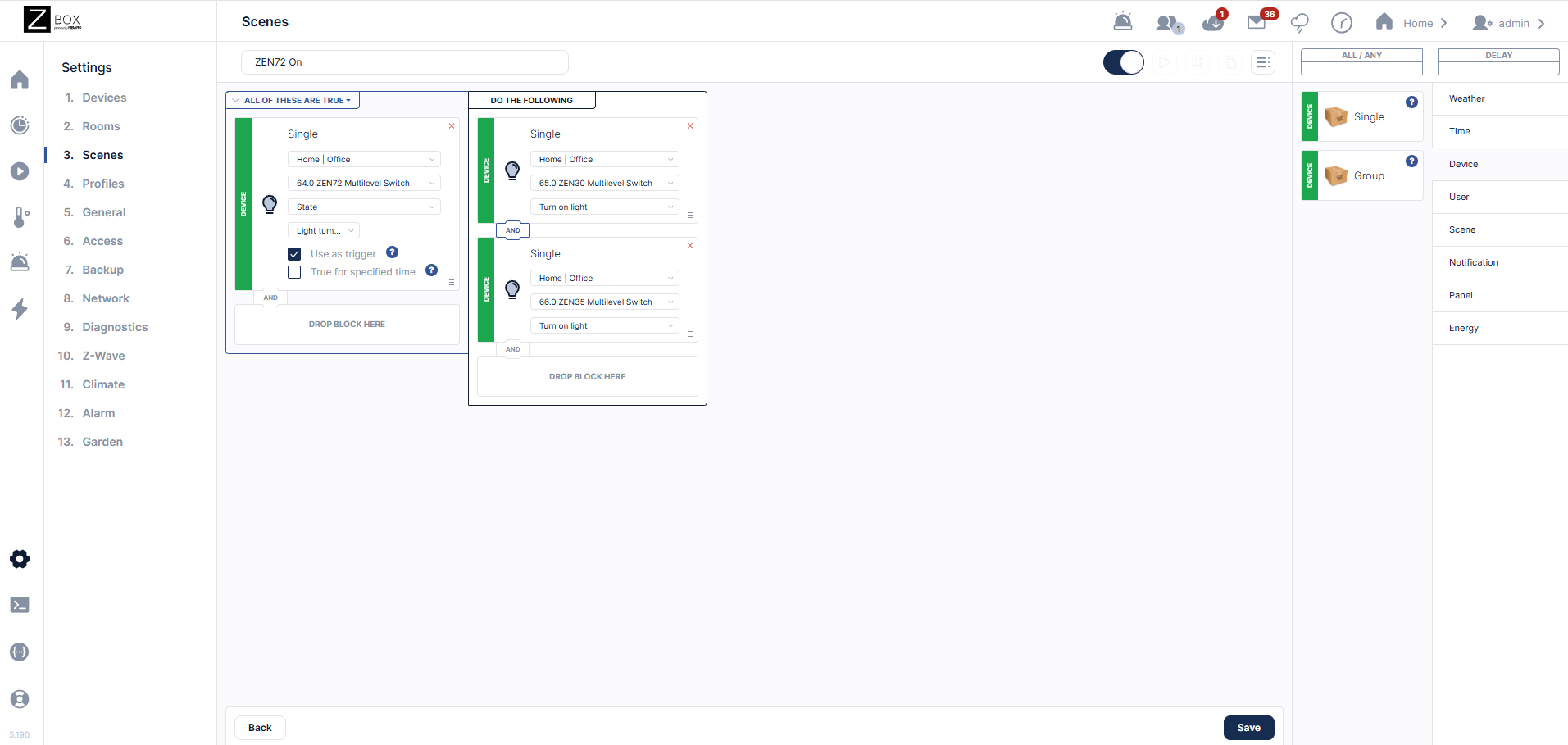
- If switch A (primary switch or dimmer) is turned on, then turn switch B and C on (where B and C are the remote control dimmers or switches).
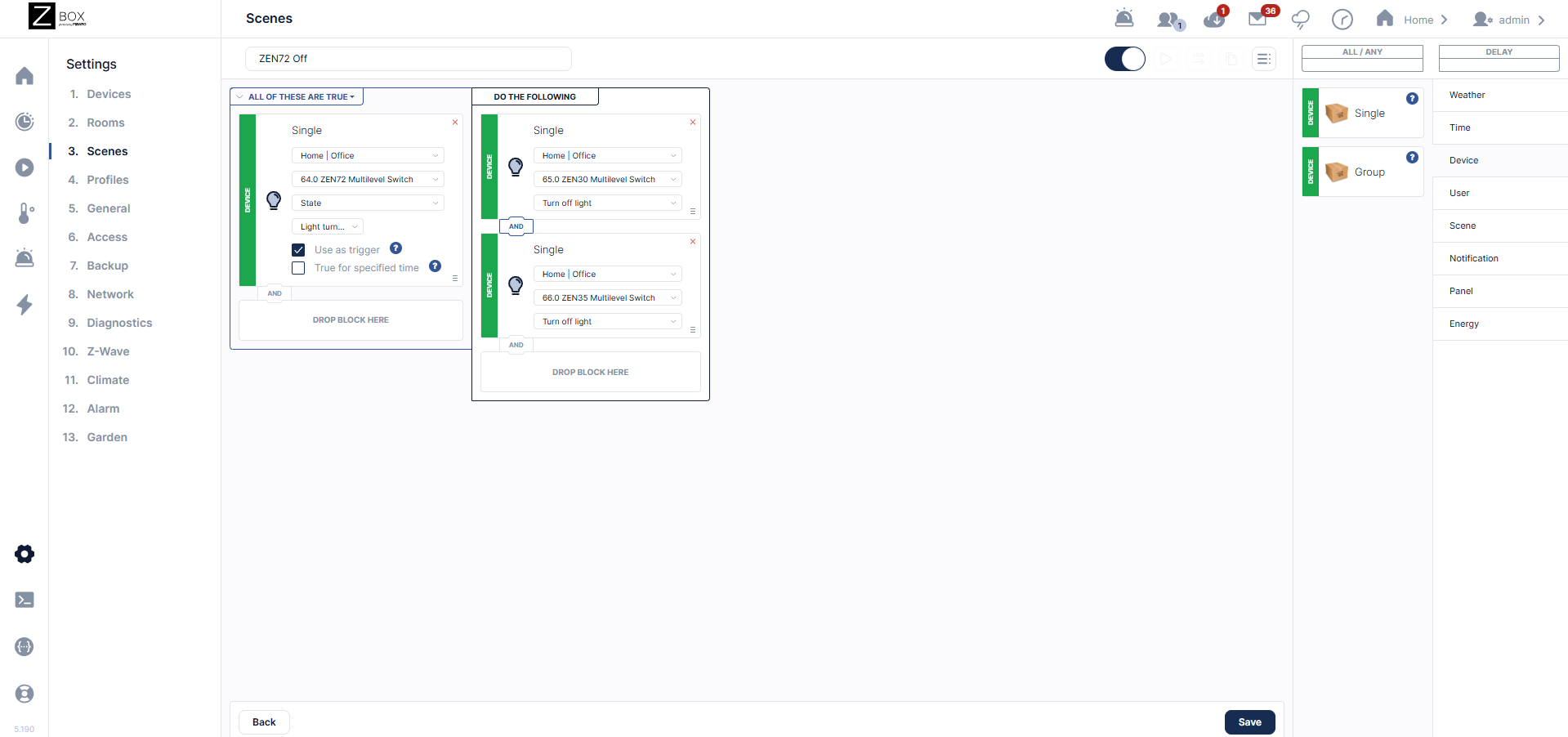
- If switch A is turned off, then turn switch B and C off.
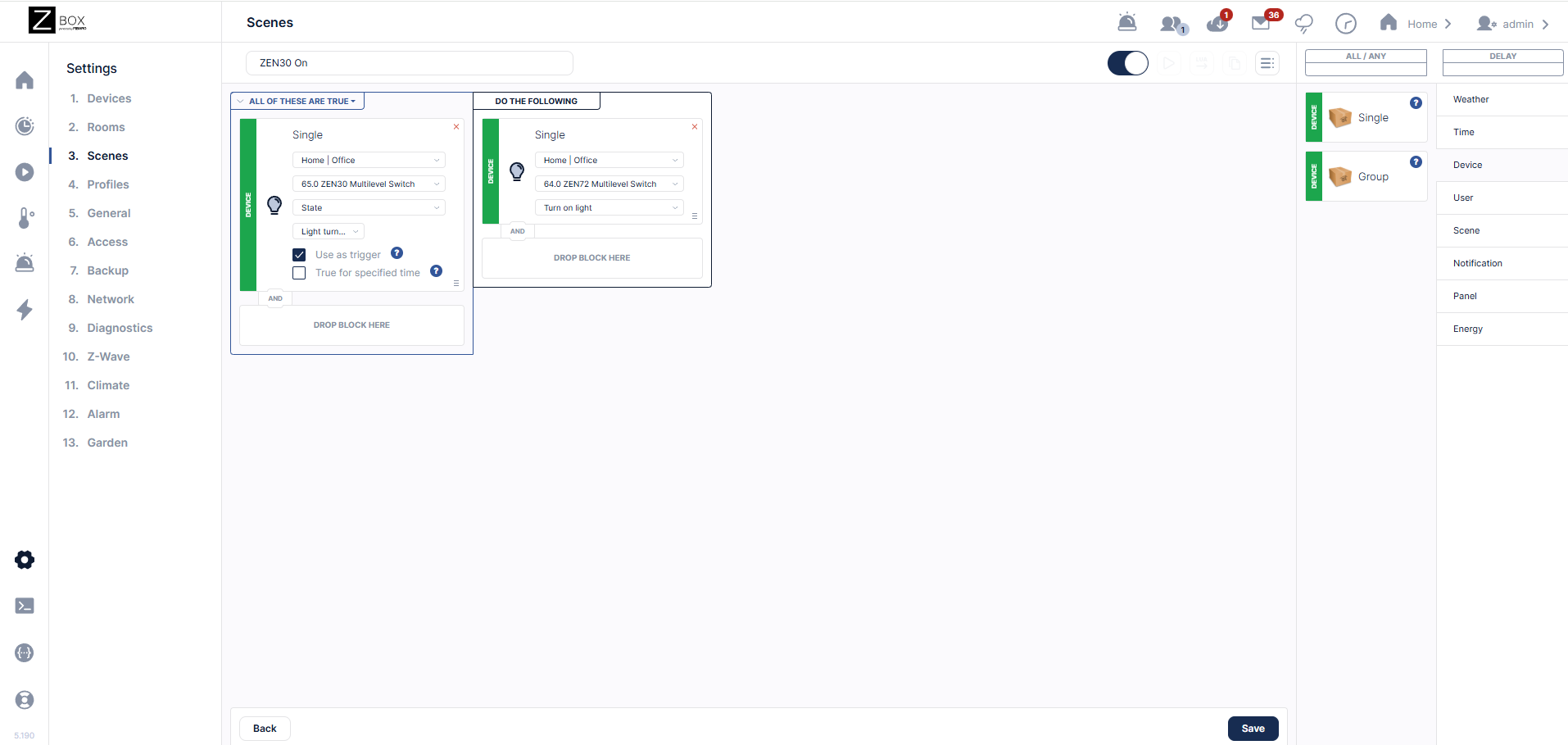
- If switch B is turned on, then turn switch A on.
- If switch B is turned off, then turn switch A off.
- If switch C is turned on, then turn switch A on.
- If switch C is turned off, then turn switch A off.
For more details on scene creation, we have a full lineup of articles here: How To Create Automations On Your Z-Box Hub
1. For your first two scenes, you'll have the status of the main dimmer as the trigger, turning the other two switches on and off. For the first scene, we're using upper paddle press on the ZEN72 (main dimmer connected to the load) and turning on the ZEN30 and the ZEN35 (remote dimmers/no load). For the second scene, we're using the lower paddle press on the ZEN72 to turn off the ZEN30 and ZEN35.
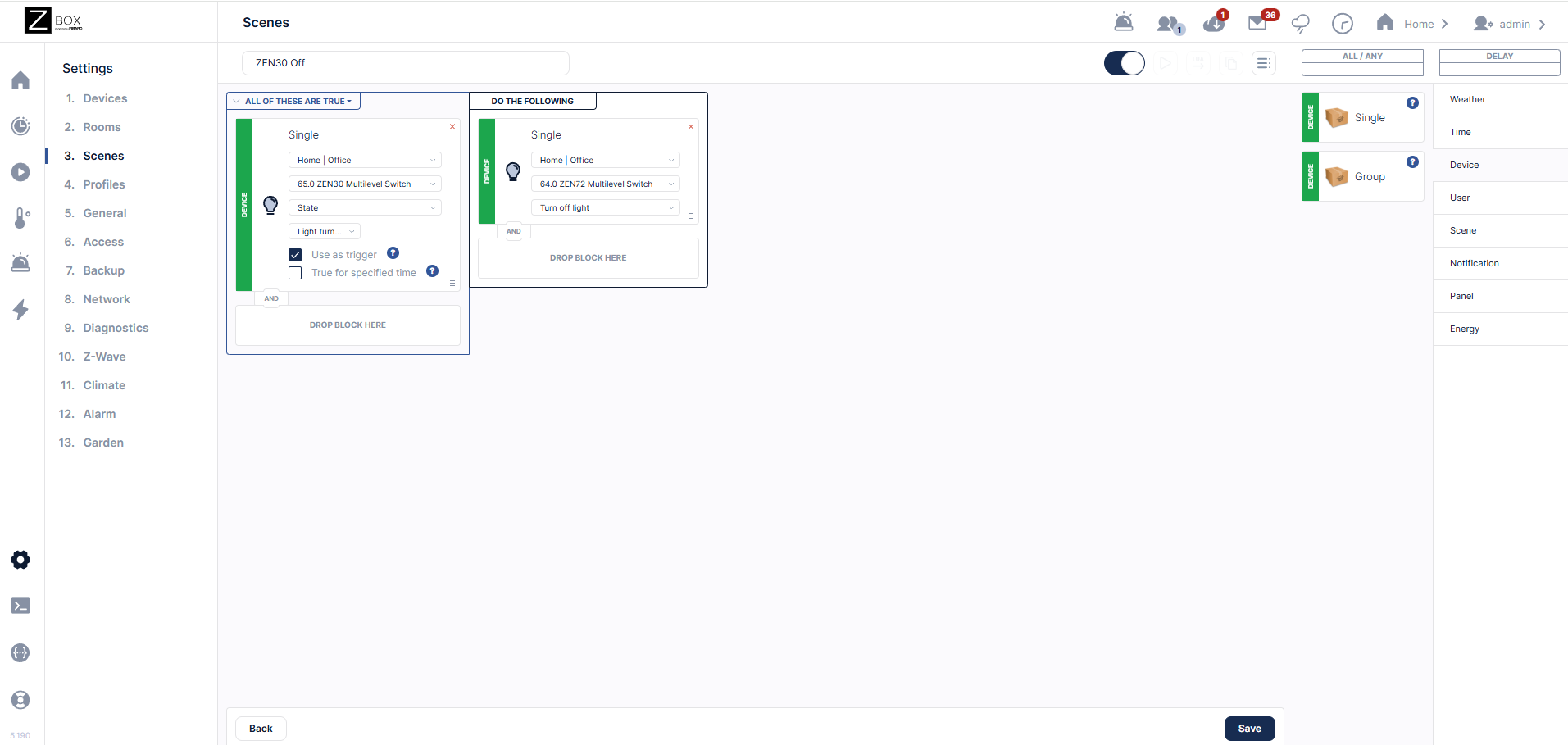
2. For the next two scenes, we'll use the second remote dimmer (ZEN30) and use the status of this switch to turn on and off the ZEN72:
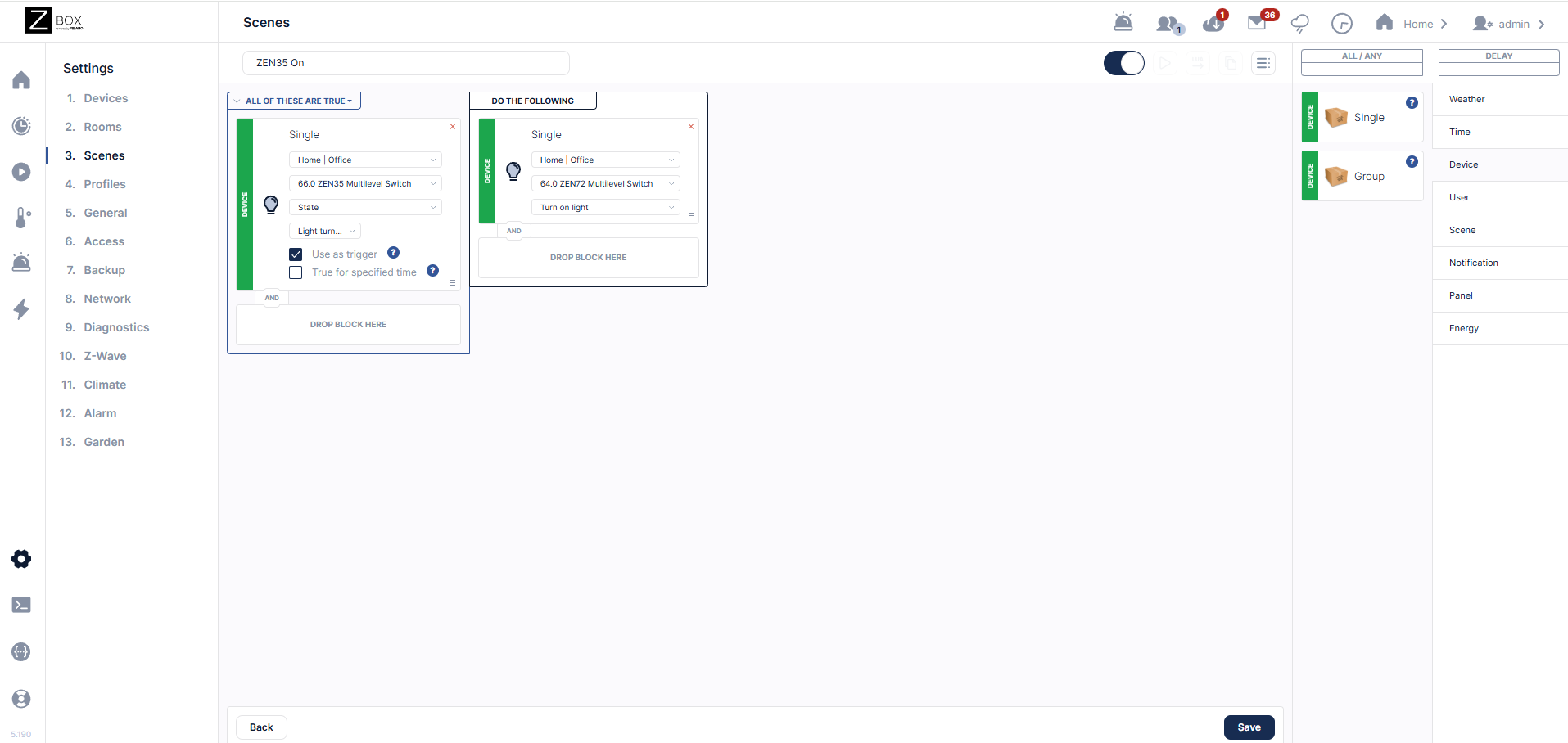
3. For the final two scenes, we'll use the last remote dimmer (ZEN35) and use the status of this switch to turn on and off the ZEN72:
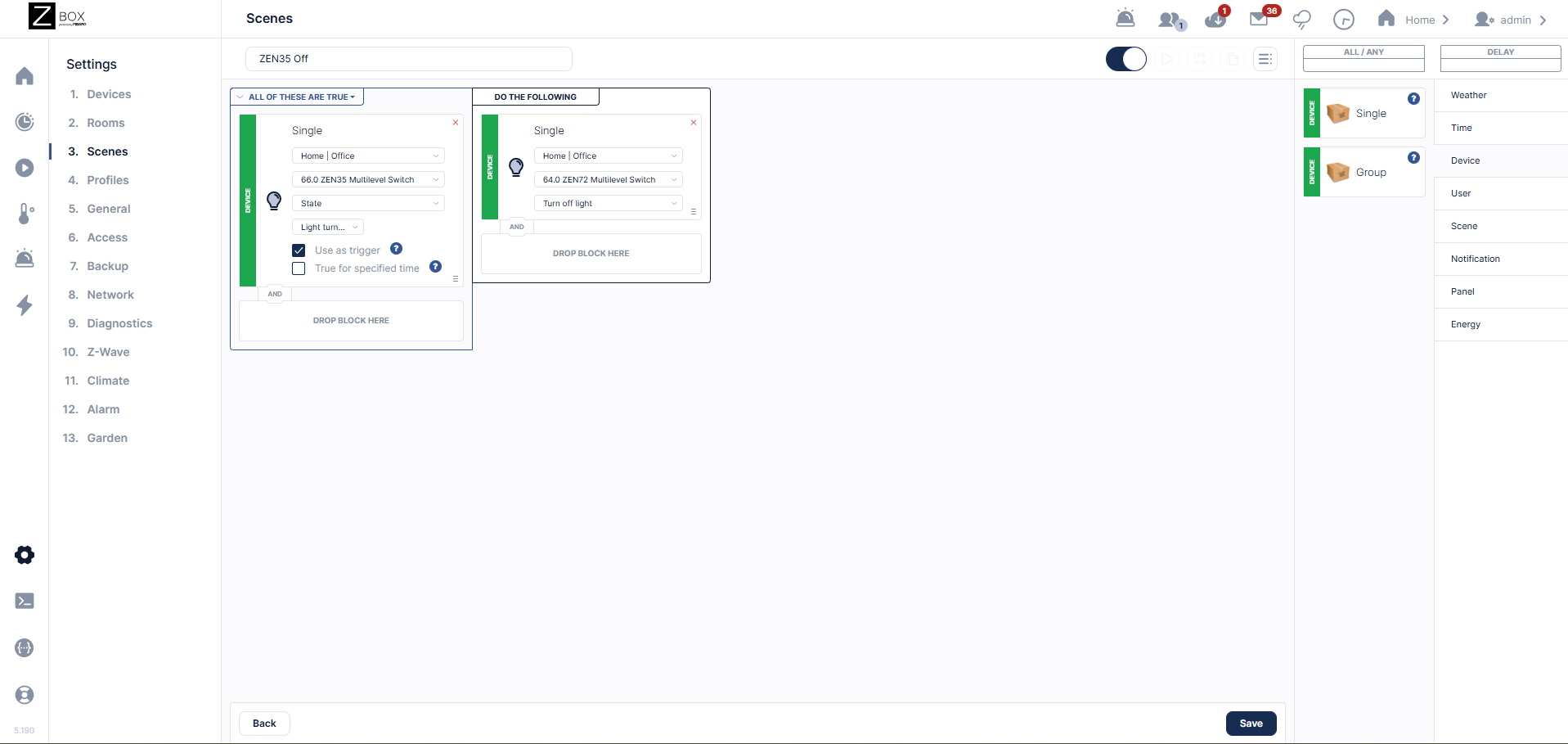
4. You will end up with 6 total scenes, in order to keep the three switches in sync:

Please let us know if you have any questions!

