


Don't forget to register your product for extended warranty and more perks:
Click here to register your device here.
FEATURES
-
Z-Wave Plus Static Controller to easily add Z-Wave communication to your smart home ecosystem
-
Latest S2 security protocol for a truly private network
-
800 Series Long Range Z-Wave for fast, low-power direct communication
-
Extended range up to a mile in open space when using Long Range
-
Designed for Raspberry Pi and Home Assistant Yellow hardware
SPECIFICATIONS
-
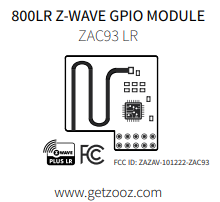
Model Number: ZAC93 LR
-
Z-Wave Frequency: 908.42 MHz
-
Power: 3.3 VDC
-
Operating Temperature: 32-104° F
-
Operating Humidity: Up to 85%
-
Installation and Use: Indoor only
-
Dimensions: 1.1" x 1.1"
SETUP
Use this 800 Series Z-Wave Plus GPIO Module as a wireless radio for your host controller, such as Raspberry Pi. Follow the detailed instructions in the link below to connect the module. Please proceed with caution when installing the device.
ZAC93 800 GPIO Module Installation Guide
Once the controller is set up and connected to your home automation soware, you can enjoy a fully secure, private Z-Wave Plus mesh network. If the soware supports Z-Wave Long Range, enable direct communication between your devices and the controller for supreme range up to 1 mile and a larger network size up to 4000 nodes.
GPIO MODULE AS SECONDARY CONTROLLER: You can use the GPIO module as a secondary controller to your current ZWave system if it accepts additional controllers. To enroll the module in your current system, send the inclusion command and put the module into learning mode, using the SerialAPI mode in the interface.
FACTORY RESET
The GPIO Module can only be reset by the host soware while it’s in SerialAPI mode. The device is reset once an appropriate command from the host soware is sent to reset the Z-Wave network. There is no way to manually reset the module without a connection to the host soware.
WARNING
-
This product should be installed indoors upon completion of any building renovations.
-
Do not install the device in a place with direct sun exposure, high temperature, or humidity.
-
Keep away from chemicals, water, and dust.
-
Ensure the device is never close to any heat source or open flame to prevent fire.
-
Ensure the device is connected to an electric power source that does not exceed the maximum load power.
-
No part of the device may be replaced or repaired by the user.
S2
This product can be included and operated in any Z-Wave network with other Z-Wave certified devices from other manufacturers and/or other applications. All non-battery operated nodes within the network will act as repeaters regardless of vendor to increase reliability of the network. This product features the latest Security 2 (S2) framework to remove smart home network hacking risks. This device is equipped with a unique authentication code for trusted wireless communication.
WARRANTY
This product is covered under a standard 12-month warranty and an extended 5-year limited warranty once registered. To read the full warranty policy or file a warranty claim, please go to: www.getzooz.com/warranty.
REGISTER YOUR PRODUCT HERE: www.getzooz.com/register.
FCC NOTE THE MANUFACTURER IS NOT RESPONSIBLE FOR ANY RADIO OR TV INTERFERENCE CAUSED BY UNAUTHORIZED MODIFICATIONS TO THIS EQUIPMENT. SUCH MODIFICATIONS COULD VOID THE USER’S AUTHORITY TO OPERATE THE EQUIPMENT. STORE INDOORS WHEN NOT IN USE. SUITABLE FOR DRY LOCATIONS ONLY. DO NOT IMMERSE IN WATER. NOT FOR USE WHERE DIRECTLY EXPOSED TO WATER. This device complies with Part 15 of the FCC Rules. Operation is subject to the following conditions:
-
This device may not cause harmful interference
-
This device must accept any interference received, including interference that may cause undesired operation.
This equipment has been tested and found to comply with the limits for a Class B digital device, pursuant to part 15 of the FCC Rules. These limits are designed to provide reasonable protection against harmful interference in a residential installation. This equipment generates, uses and can radiate radio frequency energy and, if not installed and used according to instructions, may cause harmful interference to radio communications. However, there is no guarantee that interference will not occur in any given installation. If this equipment causes harmful interference to radio or television reception, the user may try to correct the interference by taking one or more of the following measures:
-
Reorient or relocate receiving antenna
-
Increase the separation between equipment and receiver
-
Connect equipment into a separate outlet or circuit from receiver
-
Consult the dealer or an experienced radio/TV technician for additional assistance
FCC Part 15 Subpart C 15.215 & 15.205 & 15.207 & 15.209 & 15.249
2.3 Specific operational use conditions:
-
The module is an SRD module.
-
Operation Frequency: 908.40 - 920.00 MHz
-
Modulation: FSK
-
Type: On-board antenna
-
Gain: -2.75 dBi
-
The module can be used for mobile or applications with a maximum -2.75 dBi antenna.
The host manufacturer installing this module into their product must ensure that the final Composite product complies with the FCC requirements by a technical assessment or evaluation to the FCC rules, including the transmitter operation. The host manufacturer has to be aware not to provide information to the end user regarding how to install or remove this RF module in the user's manual of the end product which integrates this module. The end user manual shall include all required regulatory information/warning as show in this manual.
2.4 Limited module procedures:
-
Applicable. The module is a Limited module and complies with the requirement of FCC Part 15.249.
2.5 Trace antenna designs:
-
Not applicable. The module has its own antenna, and doesn’t need a host’s printed board microstrip trace antenna etc.
2.6 RF exposure considerations:
-
The module must be installed in the host equipment such that at least 20cm is maintained between the antenna and users’ body; and if RF exposure statement or module layout is changed, then the host product manufacturer required to take responsibility of the module through a change in FCC ID or new application. The FCC ID of the module cannot be used on the final product. In these circumstances, the host manufacturer will be responsible for re-evaluating the end product (including the transmitter) and obtaining a separate FCC authorization
2.7 Antennas:
Antenna Specification are as follows:
-
Type: On-board antenna
-
Gain: -2.75 dBi
This device is intended only for host manufacturers under the following conditions: The transmitter module may not be co-located with any other transmitter or antenna; The module shall be only used with the internal antenna(s) that has been originally tested and certified with this module. The antenna must be either permanently attached or employ a ‘unique’ antenna coupler. As long as the conditions above are met, further transmitter test will not be required. However, the host manufacturer is still responsible for testing their end-product for any additional compliance requirements required with this module installed (for example, digital device emissions, PC peripheral requirements, etc.).
2.8 Label and compliance information:
Host product manufacturers need to provide a physical or e-label stating “Contains FCC ID: 2AZ2V-101222ZAC93” with their finished product.
2.9 Information on test modes and additional testing requirements:
Operation Frequency: 908.40 - 920.00 MHz Modulation: FSK Host manufacturer must perform test of radiated & conducted emission and spurious emission, etc according to the actual test modes for a stand-alone modular transmitter in a host, as well as for multiple simultaneously transmitting modules or other transmitters in a host product. Only when all the test results of test modes comply with FCC requirements, then the end product can be sold legally.
2.10 Additional testing, Part 15 Subpart B disclaimer:
The modular transmitter is only FCC authorized for FCC Part 15 Subpart C 15.215 & 15.205 & 15.207 & 15.209 & 15.249 and that the host product manufacturer is responsible for compliance to any other FCC rules that apply to the host not covered by the modular transmitter grants of certification. If the grantee markets their product as being Part 15 Subpart B compliant (when it also contains unintentional-radiator digital circuitry), then the grantee shall provide a notice stating that the final host product still requires Part 15 Subpart B compliance testing with the modular transmitter installed.
© Zooz 2025

